Spring 2026
Branch Prediction: TAGE and Perceptron Predictors on SPEC
A project that took TAGE and perceptron predictors as starting points, designed six variants on top of them, and measured all of it against SPEC benchmarks as Intel Pin tools.
- systems
- data
Outcome
Branch predictors measured over real program execution rather than traces. Baseline TAGE reaches 99.93% accuracy on libquantum and tops out at 96.5% on dealii, and the parameter sweeps show which settings do the work: table count accounts for nearly all of it, while global history past 40 bits adds close to nothing on either benchmark. The team then designed six variants of its own, four on TAGE and two on the perceptron predictor, and measured them the same way. No single design won outright. Which predictor came out ahead depended on the benchmark, which is the same pattern the parameter sweeps show at a smaller scale: the workload decides what is worth paying for.
A four-person project, worked on collectively rather than split by part.
Motivation
Most modern branch predictors descend from TAGE. It clearly works, so the question worth answering is which of its knobs pay for themselves, given that every extra table and history bit costs silicon, and whether a variant can do better than the shape everyone already uses.
Experience, learning & skills
- Designed six original predictor variants: adaptive history length selection, alternative replacement policies, a confidence predictor, a history-overfit predictor, and two PC-bias designs
- Extended the same treatment to perceptron predictors with confidence-gated global history, a confidence update rule, and dynamic threshold designs
- Built the predictors as Intel Pin tools, so accuracy is measured against real instruction streams rather than a trace file
- Ran the benchmark matrix on a compute cluster through SLURM batch jobs
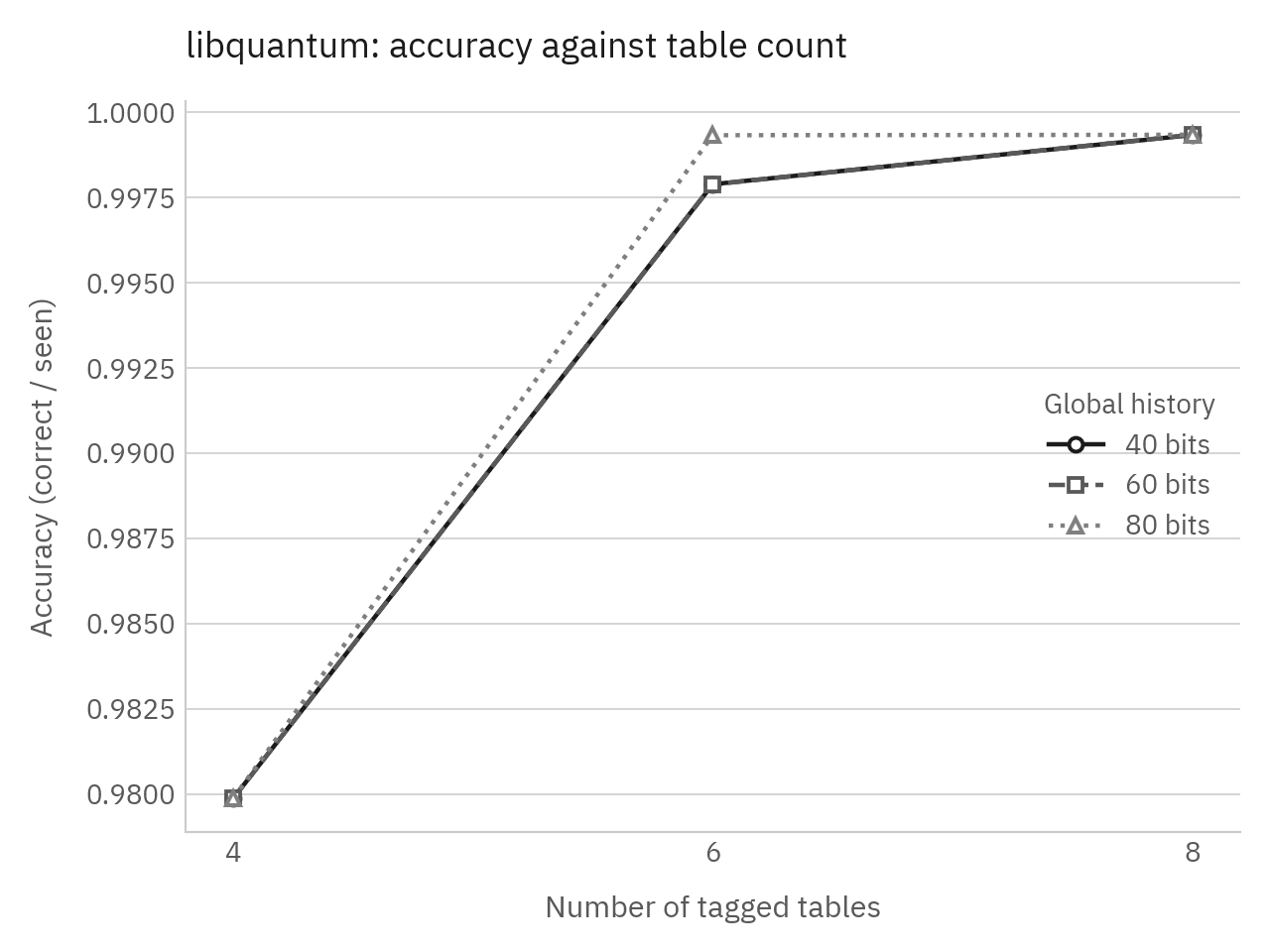
libquantum: the sixth table is where the returns stop. The three history lengths are nearly indistinguishable.
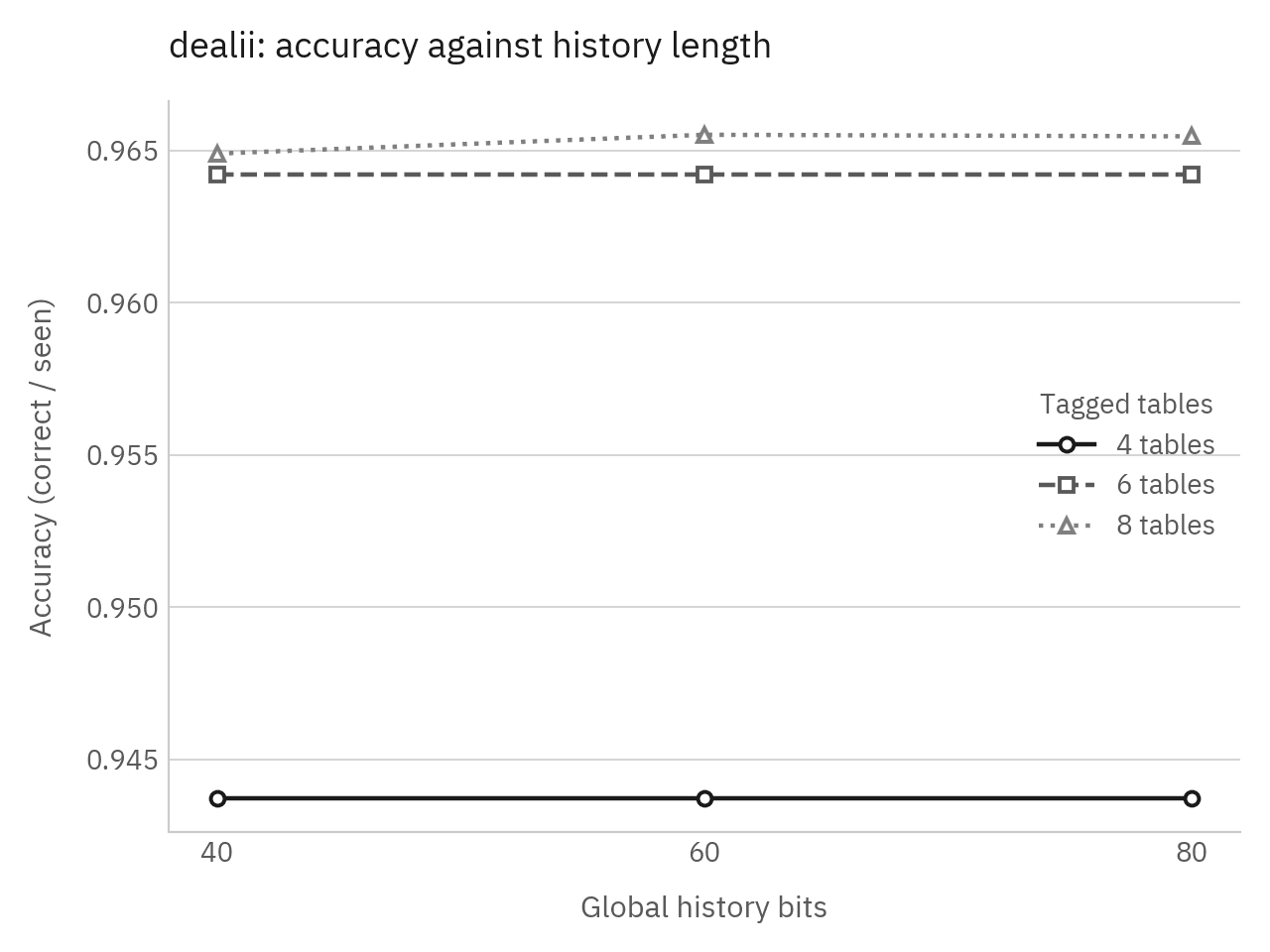
dealii: the lines are flat but clearly separated. History length barely matters here. Table count is what moves the number.
Technical details
Each tagged table entry holds a prediction counter, a tag, and a 2-bit saturating useful counter. A table is indexed by XOR-folding the branch PC against a slice of the global history register, with each table taking a longer slice than the last; the prediction comes from the hit table using the longest history, falling back to the base table when nothing hits. On a misprediction the predictor allocates into a table with longer history, preferring entries whose useful counter has decayed to zero, and at most one entry is allocated per misprediction.
On libquantum, accuracy climbs from 98.0% to 99.9% between four and six tables and then flattens out, so the eighth table costs silicon and returns almost nothing. On dealii the curve is lower and differently shaped: table count still matters, moving 94.4% to 96.5%, but history length is almost flat across 40, 60, and 80 bits. The two benchmarks gave different answers about which knob is worth paying for.